How to add Vivint Smart Devices to HomeKit


Vivint is a professionally installed security setup with its own Smart Hub panel, cameras, locks, and sensors. If your home runs on Apple devices, you might be wondering if Vivint can work with Apple HomeKit. While it doesn’t work natively, you can easily connect the two using a bridge. Below, we break down supported devices, the best setup methods, and step-by-step instructions for each.
There are four ways to connect Vivint with HomeKit:
Which Vivint Devices Can You Add to Apple HomeKit?
No Vivint security equipment supports Apple HomeKit out of the box, meaning your gear won’t appear in the Apple Home app automatically. However, the verified homebridge-vivint plugin lets you integrate most of your Vivint ecosystem into Apple Home for seamless control from your iPhone.
| Vivint Device | Native HomeKit | With homebridge-vivint | Notes |
|---|---|---|---|
| Smart Hub alarm panel | No | Yes | Arm home, arm away, and disarm |
| Smart Lock | No | Yes | Lock and unlock |
| Door and window sensors | No | Yes | Contact sensors |
| Tilt sensors | No | Yes | Garage tilt detection |
| Motion sensors | No | Yes | Can create occupancy sensors that stay active for a set time |
| Smart Thermostat | No | Yes | Temperature control and modes |
| Garage door opener | No | Yes | Open and close control |
| Cameras and doorbell cameras | No | Yes | Live view via Smart Hub or Vivint servers (HomeKit Secure Video not supported) |
| Safety sensors (Smoke, CO, Glass break, Heat, Freeze) | No | Yes | Real-time hazard alerts |
| Z-Wave switches paired with panel | No | Yes | Label as "light" or "fan" in Vivint to display correctly |
- Alarm panel: In the Apple Home app, you can arm home, arm away, and disarm your Smart Hub panel.
- Cameras: Live video streams directly from the Smart Hub or Vivint's servers. HomeKit Secure Video is not listed, so recorded clips stay in the Vivint app.
- Vivint app features: Professional monitoring, recorded video, and Smart Deter settings are still managed in the Vivint app.
Which Vivint HomeKit Method Should You Use?
| Feature | AddToHomeKit | ATH Bridge | Homebridge | HOOBS |
|---|---|---|---|---|
| What it is | Guided setup that walks you through the plugin | Plug-and-play box with Homebridge preinstalled | Free, open-source bridge on your own computer | Homebridge hub with its own interface |
| Vivint plugin | homebridge-vivint | homebridge-vivint | homebridge-vivint | homebridge-vivint |
| Extra hardware | A Homebridge host (your computer or ATH Bridge) | The ATH Bridge box | Always-on computer or Raspberry Pi | The HOOBS box |
| Vivint MFA login | Plugin settings screen | Plugin settings screen | Plugin settings screen | Terminal command |
| Setup effort | Low | Low | Medium | Medium |
| Best for | Beginners | Hands-off hardware | Tinkerers on a budget | Existing HOOBS owners |
Using another security brand? See our ADT and Ring HomeKit guides.
How Do You Connect Vivint to Apple HomeKit?
Every method below uses the same community plugin, homebridge-vivint, which connects securely to your Vivint account and adds your devices to Apple Home. The main difference is simply where the plugin runs: a guided setup, a dedicated plug-and-play hub, your own computer, or a HOOBS box. Whichever you choose, you can keep using the official Vivint app alongside HomeKit
AddtoHomeKit - Best Solution
The easiest way to integrate your non-HomeKit devices with Apple HomeKit is by using AddToHomeKit. Simply follow the straightforward steps to manage your Vivint devices through the Apple Home app and control them with Siri voice commands.
Follow these steps to integrate vivint devices with Apple HomeKit using Addtohomekit
- Visit the AddtoHomeKit official page
- Select the preferred ecosystem
- Select the preferred solution
- Select the preferred Operating System
- Install the homebridge-vivint plugin (@balansse/homebridge-vivint)
- Now select the Activation Package
- Then, Follow the on-screen instructions as mentioned
Pros and Cons of AddtoHomeKit
Pros
- A step-by-step guided setup points you directly to the correct Vivint plugin.
- It requires low technical effort for users who have never set up a bridge.
- The same setup process works for adding other non-HomeKit brands to Apple Home.
Cons
- You must activate an account before you can begin setup
- It still requires an active Homebridge host, such as your computer or ATH Bridge, running on your network.
- It relies on the unofficial homebridge-vivint plugin to link your hardware.
Best for: Beginners who want guided help adding Vivint to Apple Home.
You can even create a Geeni HomeKit and a Levoit HomeKit with this! You can also add ADT devices to HomeKit, add Eufy devices to HomeKit and even add Sonos devices to HomeKit or other incompatible devices using AddtoHomeKit.
ATH Bridge
The ATH Bridge is a small plug-and-play box with Homebridge already installed, so you don't need to set up a Raspberry Pi or keep a computer running. Install the homebridge-vivint plugin from its Homebridge UI and sign in with your Vivint account, following the same steps as the Homebridge section below.
Pros and Cons of ATH Bridge
Pros
- Homebridge comes preinstalled, eliminating the need for SD card flashing or Raspberry Pi setup.
- The small, always-on hardware box stays connected continuously to your home network.
- It uses the standard homebridge-vivint setup process shared by all Homebridge installations.
Cons
- It requires buying dedicated hardware rather than using existing devices.
- You must still sign in to Vivint and enter your authentication code in the plugin settings.
- It relies on an unofficial plugin that backend Vivint updates can temporarily break.
Best for: Vivint owners who want a dedicated box and no server to maintain.
Homebridge: The Software Method
Homebridge is basically a software that can be used to integrate Vivint and HomeKit. It's free and open source, but it needs a computer or Raspberry Pi that stays on.
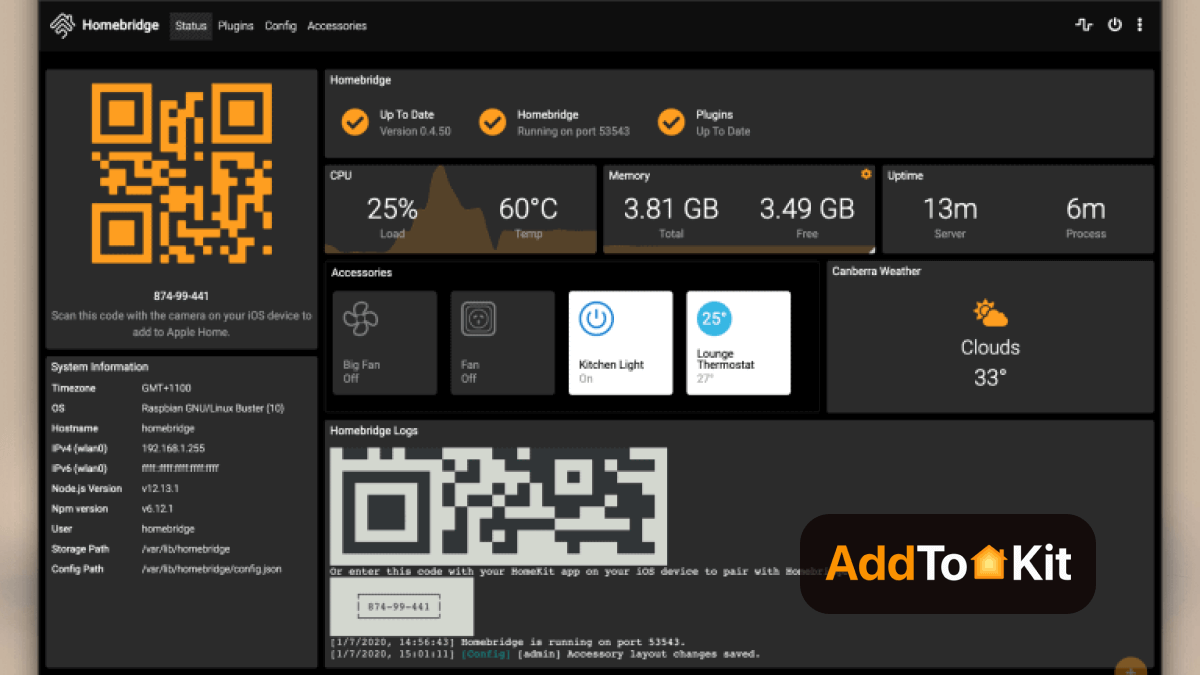
- Install Homebridge: Set up Homebridge on a Raspberry Pi, Mac, Windows PC, or Linux computer, then open the Homebridge UI at
http://homebridge.local:8581. - Install the Vivint plugin: Open Plugins, search for
homebridge-vivintand install@balansse/homebridge-vivint, the version marked Verified by Homebridge. - Sign in to Vivint: Open the plugin settings and enter your Vivint username and password, then enter the MFA code sent to your authenticator app, phone, or email. The plugin generates and saves a refresh token for you.
- Restart Homebridge: Click Save, then restart Homebridge. The plugin will automatically detect and load all your supported Vivint devices.
- Add Homebridge to the Home app: If Homebridge isn't paired yet, open the Apple Home app, tap the plus button (+), choose Add Accessory, and scan the QR code on your Homebridge dashboard.
- Check your devices: Your Vivint devices will now appear in the Home app. Assign them to rooms, then test arming, locking, and sensor triggers before creating automations.
To set it up by hand instead, add this to the platforms array in your Homebridge config.json:
{
  "platform": "Vivint",
  "refreshToken": "your-vivint-refresh-token"
}
Tip: The plugin's original author suggests creating a separate Vivint user named "Apple Home", so the Vivint activity log shows which actions came from HomeKit.
homebridge-vivint is a community plugin. It is not made, supported or endorsed by Vivint or Apple, and Vivint updates can stop it working. Keep the plugin up to date.
Pros and Cons of HomeBridge
Pros
- The Homebridge software platform is completely free and open source.
- The homebridge-vivint integration carries the Verified by Homebridge badge.
- You get full control over plugin settings, including the ability to hide specific devices.
Cons
- It requires a computer or Raspberry Pi that must stay powered on continuously.
- You must install software updates and troubleshoot issues yourself without support from Vivint or Apple.
- It relies on an unofficial plugin, and features like HomeKit Secure Video are not listed.
Best for: Hands-on users who already run Homebridge or want a free setup.
Using HOOBS: A Pre-Programmed Homebridge Server
You can install and use Homebridge from your PC. But it would be best if you kept it turned on constantly, or else it will lose the connection. This is why it is recommended to use a Homebridge server like HOOBS.
The setup process for HOOBS is as follows:
- Connect the HOOBS box to your network with Wi-Fi or an Ethernet cable.
- Go to http://hoobs.local and create an admin account.
- Add the HOOBS bridge to the Apple Home app with Add Accessory.
- Open Plugins, search for
homebridge-vivintand install@balansse/homebridge-vivint. - HOOBS can't show the plugin's login screen, so create the refresh token in the terminal, as described in the plugin's README. Open the HOOBS terminal and run the commands below, replacing
vivintbridgewith your bridge name in lowercase with no spaces. Enter your Vivint login and MFA code when asked:cd ~/.hoobs/etc/vivintbridge/node_modules/@balansse/homebridge-vivint && npm run mfa - Open the plugin's configuration, paste the token into the config below, then save and restart the bridge. Your Vivint devices then appear in the Home app:
{
  "platform": "Vivint",
  "refreshToken": "your-vivint-refresh-token"
}
Pros and Cons of HOOBS
Pros
- It serves as a plug-and-play Homebridge hub for your smart home setup.
- It features a user-friendly interface for managing your plugins and system configuration.
- It can run plugins for multiple smart home brands simultaneously on one device.
Cons
- HOOBS cannot display the plugin's login screen, so multi-factor authentication requires running a terminal command.
- Product availability and ongoing support need to be verified before you buy.
- It relies on the unofficial homebridge-vivint plugin for system integration.
Best for: People who already own a HOOBS box.
You can also integrate Honeywell HomeKit using HOOBS solution.
Why Add Vivint to Apple HomeKit?
Adding Vivint to Apple HomeKit through a bridge lets you control your security hardware alongside the rest of your Apple smart home.
- Siri voice control: Use Siri on your iPhone to lock doors or arm your Vivint system hands-free.
- Home app automations with non-Vivint devices: Build routines across brands, such as turning on non-Vivint smart lights when a Vivint door sensor opens.
- One app for everything: Control Vivint hardware in the Apple Home app next to your other HomeKit compatible smart devices.
- Apple Home notifications: Get Home app alerts on your iPhone when a Vivint sensor changes or the alarm state changes.
Why Isn't Vivint Working in Apple Home?
- Plugin can't sign in: Your refresh token may have expired, or multi-factor authentication was not completed during setup. Sign in again in the plugin settings with your authentication code, or run
npm run mfain the terminal if you use HOOBS. - No Response: This appears when the device running Homebridge goes offline or the Vivint session drops. Restart Homebridge, and make sure
apiLoginRefreshSecsis not set to renew more often than every 10 minutes. - Device missing: Not every Vivint accessory is supported. Turn on
logDeviceListin the plugin settings to see what the plugin found. If Z-Wave switches don't appear, label them "light" or "fan" in Vivint. - Old devices still showing: The plugin removes accessories from its cache once they are no longer on your Vivint system. Restart Homebridge to refresh the list.
- Unreliable motion automations: Vivint motion events can arrive late, out of order or not at all. Avoid HomeKit automations based on Vivint motion, and use door sensors or the alarm state as triggers instead.
- Camera won't stream: Turn on
useExternalVideoStreamsto stream from Vivint's servers instead of the panel. If you only need sensors and locks, turn ondisableCameras. - No remote control: Controlling devices away from home needs an Apple home hub. Set up a HomePod, Apple TV or Apple HomeView on your home network.
- Stopped after a Vivint update: This bridge uses an unofficial plugin, so Vivint updates can break it. Update homebridge-vivint to the latest version and check its GitHub issues for known problems.
If you'd rather have a security system that connects to Apple Home without a bridge, see our Abode guide.
Does Vivint Work with Apple HomeView?
Not natively. Apple HomeView is a smart display that acts as a home hub for Apple Home accessories, but Vivint devices do not appear on it on their own because they are not HomeKit or Matter accessories. To use your security system on HomeView, you should add Vivint to the Apple Home app first using one of the bridge methods in this article. Apple has not said how bridged accessories appear on HomeView.
Researched on Apple's HomeView page. Checked on 4 November 2026. HomeView goes on sale on 13 November 2026.
Which Vivint HomeKit Method Is Best?
If you want guided help, start with AddtoHomeKit. If you'd rather not keep a computer running, ATH Bridge gives you a dedicated Homebridge box that runs the Vivint plugin around the clock. Experienced users can run Homebridge themselves for free. Whichever you choose, the same homebridge-vivint plugin does the work, so keep it updated and keep the Vivint app for monitoring and alarm settings.
FAQs
Install the homebridge-vivint plugin on your Homebridge server, ATH Bridge, or HOOBS setup because Vivint lacks native integration. Sign in using your Vivint account credentials and multi-factor authentication code. Finally, open the Apple Home app on your iPhone and tap Add Accessory to scan your bridge. All your supported security devices will then load automatically into the app.
Not natively. Apple HomeView is a home hub with a screen designed for Apple Home accessories, but Vivint devices do not appear on it on their own. You must add Vivint with a bridge first using one of the setup methods. Apple has not said how bridged accessories will appear on the HomeView display.
You can add your Smart Hub alarm panel, Smart Lock, thermostat, and garage door opener. The integration also supports door, window, tilt, and motion sensors, alongside safety sensors for smoke, carbon monoxide, glass break, heat, and freeze detection. Connected cameras, video doorbells, and Z-Wave switches paired with the Vivint panel can also be imported.
Yes, once your alarm panel is added to Apple Home. The plugin supports arm home, arm away, and disarm voice commands through Siri. However, advanced system management remains separate from Siri control. Features like professional 24/7 monitoring, alarm history logs, and core hardware settings stay strictly inside the official Vivint mobile app.
Yes. Security cameras and video doorbells are supported by the plugin for live viewing inside the Apple Home app. Video streams from your Smart Hub, or from Vivint's servers if you turn on the external stream setting. HomeKit Secure Video is not listed, and stored video recordings and Smart Deter settings stay inside the Vivint app.
Yes, the plugin specifically lists doorbell cameras for integration. You can access a live video stream of your front porch directly inside the Apple Home app. Note that HomeKit Secure Video is not listed for these devices, and features such as video recording clips remain managed within your main Vivint app.
Yes. Door sensors, window sensors, and security system states make good automation triggers, such as turning on lights when a door opens. However, plugin documentation warns that Vivint motion events can be delayed, out of order, or missed. You should avoid motion triggers, though the plugin can generate virtual occupancy sensors instead.
You need your Vivint account login, multi-factor authentication access, the homebridge-vivint plugin, and a hardware host like an ATH Bridge, HOOBS box, or always-on computer. Setting up a Vivint HomeKit integration for remote control and automations also requires an Apple home hub, such as a HomePod, Apple TV, or Apple HomeView display.
Yes. You enter your Vivint username and password into the plugin configuration, followed by the verification code sent via authenticator app, text message, or email. The plugin then saves a refresh token, so it does not need to keep your account password. HOOBS users create this token in the terminal instead.
Install the homebridge-vivint plugin inside your HOOBS dashboard interface. Because HOOBS cannot display the plugin's native login popup, open the HOOBS terminal, navigate to the plugin directory, and execute npm run mfa. Enter your Vivint credentials and security code, paste the generated refresh token into your configuration, then save and restart.
The Homebridge platform and the homebridge-vivint software plugin are completely free and open source to download. However, running the software requires an always-on computer or Raspberry Pi hardware host. Alternatively, purchasing dedicated hardware like an ATH Bridge or HOOBS hub involves a one-time purchase without recurring subscription fees for the plugin.
Yes. The plugin signs in to your existing Vivint account, so your Smart Hub and official app continue working normally after completing your Vivint HomeKit setup. Use the Vivint app for professional monitoring, recordings, and settings. Creating a separate Vivint user named Apple Home helps clarify your activity log.
No. Originally created by a former Vivint employee, the current fork holds the Verified by Homebridge badge but is not endorsed, sponsored, or affiliated with Vivint. Because backend Vivint software updates can temporarily break connectivity, users should keep the plugin updated and check the developer's GitHub repository for open issues.